
Australia’s 2026–27 Migration Program Planning Levels: New Paths to Permanent Residency

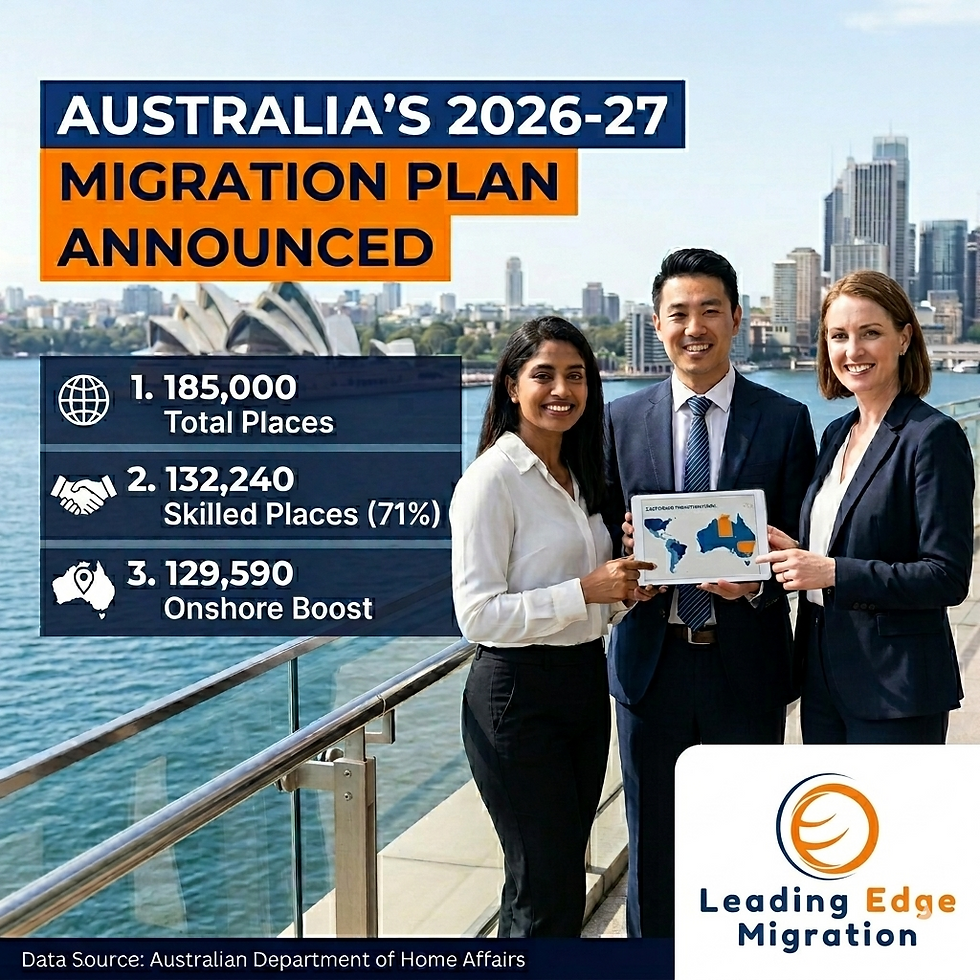
The Australian Government has officially released the permanent Migration Program planning levels for the 2026–27 financial year. While the total ceiling remains steady at 185,000 places, the internal allocation of these visas has drastically shifted. For visa applicants, understanding these shifts is crucial to building a successful Australian immigration strategy.
At Leading Edge Migration, we analyse these Department of Home Affairs updates to help you navigate changing visa eligibility frameworks. Whether you want to know how to get permanent residency in Australia, are transitioning from a temporary visa, or are an employer looking to sponsor foreign workers, this year's planning levels offer major strategic advantages.
1. Huge Onshore Boost: A Green Light for Current Residents
The defining feature of the 2026–27 permanent Migration Program is its intense focus on onshore applicants. Out of the 185,000 total permanent seats, a massive 129,590 places have been locked in exclusively for migrants already living and working in Australia.
The government’s primary goal is to provide pathways to permanent residency for temporary visa holders who are already integrated into the Australian workforce, which simultaneously helps manage Net Overseas Migration (NOM).
The Strategy: If you are currently in Australia on a Temporary Skill Shortage visa (Subclass 482), a Temporary Graduate visa (Subclass 485), or a Working Holiday visa, this onshore prioritisation means you are in a prime position to apply for PR.
2. Employer-Sponsored Visas Skyrocket
If you are aiming for an employer-sponsored permanent residency pathway, the 2026–27 allocations deliver incredible news. Places for employer-sponsored visas have surged from 44,000 up to 58,040 places.
The Strategy: This aggressive increase underscores the government's trust in business-driven migration to solve immediate skills shortages in priority sectors. If you have an eligible occupation and a supportive employer, transitioning to a Subclass 186 visa (Employer Nomination Scheme) should be your top priority.
3. Skilled Migration Program Growth (Subclass 189 & 190)
The Skilled Migration Program remains the absolute backbone of the system, swallowing up roughly 71% of the entire program with 132,240 places. Within this skilled stream, points-tested visas are seeing solid gains:
Skilled Independent Visa (Subclass 189): Increased to 21,090 places (up from 16,900), creating more room for high-scoring applicants independent of regional or employer ties.
Skilled Nominated Visa (Subclass 190): Boosted to 35,500 places. State and territory nomination programs will have expanded capacity to select qualified onshore candidates directly from their local pools.
4. Sharp Decline in Regional Visa Allocations
While independent and employer streams grew, the Regional visa category faced a steep reduction, falling dramatically to just 14,110 places.
The Strategy: With far fewer allocations for regional pathways like the Skilled Work Regional visa (Subclass 491), competition will be fierce. Applicants targeting regional areas must maximise their points or work toward regional employer-sponsored alternatives to secure their Australian PR.
5. Australian Family Program Holds Steady
The Family Migration Program keeps a stable footprint at 52,460 places (~28% of the total intake).
Partner Visas: Bumped up slightly to 41,500 places.
Child Visas: Increased to 3,500 places.
Because Partner visas and Child visas remain demand-driven categories, these numbers act as flexible targets rather than rigid caps, ensuring families can stay together.
Frequently Asked Questions (FAQs)
Q: What are Australia's Migration Program planning levels?
A: Set annually by the Department of Home Affairs, Migration Program planning levels dictate the maximum number of permanent visas that can be granted in a financial year. They direct processing priorities, dictate visa grant volumes, and shape overall Australian immigration policy.
Q: How do the new planning levels affect my chances of getting an Australian PR?
A: If you are an onshore applicant or pursuing an employer-sponsored visa, your chances have significantly improved due to major seat reallocations. However, if you rely entirely on offshore applications or regional visas, competition will be much tighter, requiring a more precise visa strategy.
Q: Is it easier to get a Subclass 186 visa under the 2026–27 program?
A: Yes. The Employer-Sponsored visa category has grown to 58,040 places. While you must still meet all visa eligibility and skill assessment requirements, the increased quota means more processing capacity and a higher likelihood of nomination.
Q: What should I do if I planned to apply for a Subclass 491 Regional Visa?
A: Because regional allocations dropped to 14,110 places, you need to maximise your points score via high English test results, partner points, or professional year credits. Alternatively, consult a migration agent to see if you can pivot to a State Nominated Subclass 190 visa or an employer-driven pathway.
Q: Will the permanent migration points test change this year?
A: The government is optimising the permanent migration points test to better select younger, highly skilled, and highly educated migrants. Ensuring your profile is completely optimised is more critical than ever to survive competitive invitation rounds.
Q: Does Australia cap the number of Partner Visas processed?
A: No. While the Australian Family Program lists an indicative target of 41,500 places for Partner visas, this stream is demand-driven. There is no hard cap, and eligible applications will continue to be processed normally.
Q: How can a registered migration agent help me with these updates?
A: Immigration laws and visa quotas shift rapidly. A registered migration agent from Leading Edge Migration will evaluate your unique qualifications, help you bypass restrictive regional caps, maximise your points score, and guide you through the fastest route to permanent residency in Australia.
Map Your PR Pathway with Leading Edge Migration
The 2026–27 permanent migration framework proves that while pathways are expanding for onshore workers, navigating the fine print requires expert calculation.
Don't leave your future to chance. Let our expert migration agents design a secure, legally sound roadmap for your immigration journey.
Why Choose Leading Edge Migration for Your Permanent Residency Application?
Navigating Australia's complex immigration system requires a strategic partner who understands how to turn shifting policy levels into successful outcomes. When you choose Leading Edge Migration, you gain access to a dedicated team of registered migration agents specialising in high-demand permanent residency pathways. Whether your goal is to secure your future through an employer-driven framework using an employer sponsored visa, claim independent points via a skilled visa, or reunite with a loved one through an Australian partner visa, we design a flawless, personalised roadmap for your unique situation. We take the guesswork out of complex visa eligibility assessments and document checklists, giving your application the competitive edge it needs to stand out in the current migration landscape.
🎯 Ready to secure your future in Australia?
Contact Leading Edge Migration Today to Schedule Your Expert PR Consultation!
📍 Visit us: 239 Adelaide Terrace, Perth
📞 Call: 08 9221 8472

Disclaimer: This blog provides general information only and does not constitute legal advice. It's crucial to consult with a registered migration agent for personalised guidance based on your specific circumstances


Comments